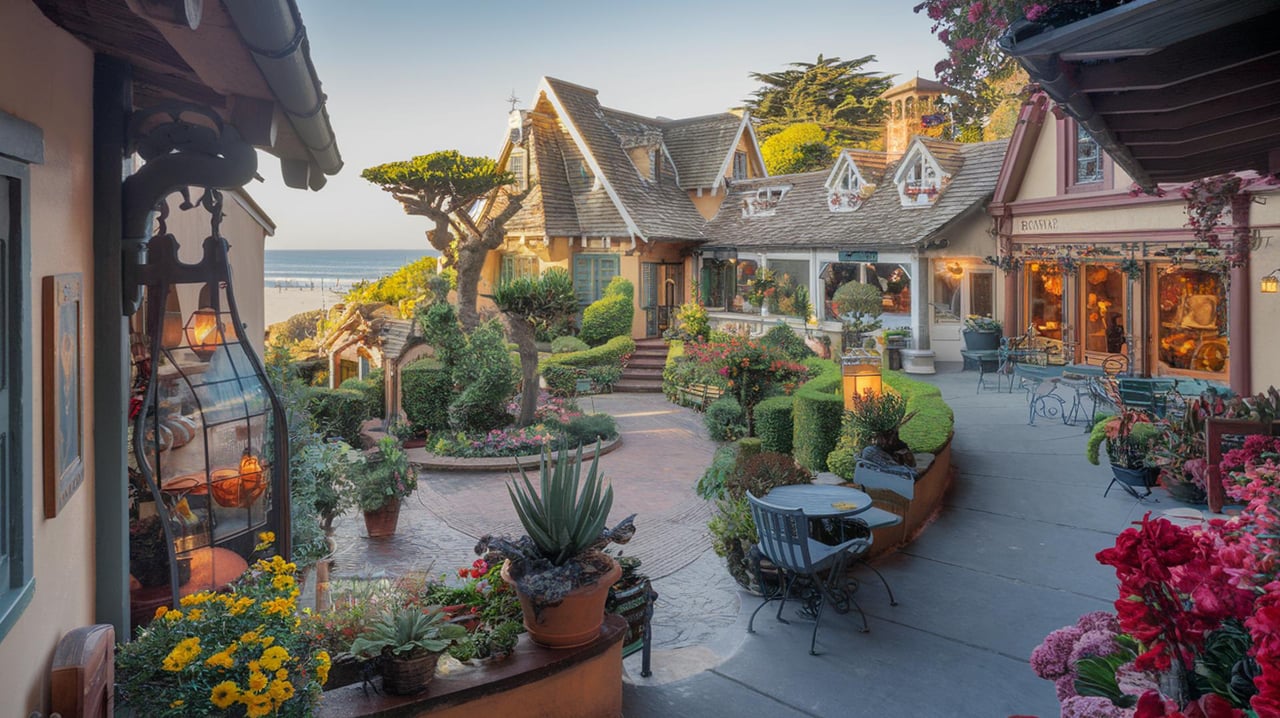
Walk Ocean Avenue in October and you can read the whole campaign from the window signs. One side says Measure M adds "just $5 to a $250 hotel room." The other says it is a "20% tax hike" that takes a guest's total to 14 percent, "higher than every city on the Monterey Peninsula." Both numbers are correct. Carmel's hotel tax is 10 percent and has not changed in 30 years. Measure M adds two points, to 12. Two on ten is twenty percent. With the separate 2 percent Hospitality Improvement District fee guests already pay, the total on a bill reaches 14.
The arithmetic is not the argument. The argument is what a village of about 3,200 residents and roughly 44 lodging properties does about a deferred maintenance backlog the city puts at about $100 million, and whether visitors or residents carry it. For someone who owns a cottage here, that question outlasts the election.
What Is on the Ballot
The council placed two measures on June 2, in a meeting that began around 10:30 that night, two and a half hours after the primary polls closed. Measure M, the hotel tax, passed the council 5-0. Measure N, a 0.375 percent sales tax increase, passed 4-1 with Councilwoman Alissandra Dramov dissenting.
Measure M establishes a new 2 percent transient occupancy tax on top of the existing 10, "until ended by voters." The June 2 staff resolution estimated $1,952,981 in new revenue and $11,717,886 in total hotel tax a year. The stated purposes on the ballot: "To upgrade streets/sidewalks, address beach erosion, enhance wildfire preparedness, maintain city trees" plus "other general government purposes." That last clause is why the opposition's website calls it "an unrestricted general tax." It is one. The money goes to the General Fund.
Measure N raises the local sales tax from 1.5 to 1.875 percent, the maximum the state allows, for about $1,887,417 in new revenue. The piece buyers miss: the existing 1.5 percent was Measure C in March 2020, approved 60.8 to 39.1 percent and set to last 20 years. Measure N's language extends the whole 1.875 percent "until ended by voters." It does not just add a sliver. It makes the entire local sales tax permanent. No argument against N was filed. The Pine Cone noted on August 21 that this would be the third sales tax increase in 14 years.
The $100 Million Behind Both
The council's March 24 five-year forecast showed costs outpacing revenue and the general fund effectively running out of money in three years. A Civitas Advisors feasibility report presented April 6 set the new annual revenue target at $6 million to $7 million against about $39 million in operating expenses, about $3 million in annual debt service, and the $100 million backlog. The options the council reviewed that night, as Pam Marino reported in Monterey County Now: a sales tax, bonds, paid parking, a real estate transfer tax, a special infrastructure district, and becoming a charter city. Civitas called paid parking revenue "modest." A transfer tax requires charter status first. On April 7 the council voted 4-1, Mayor Dale Byrne opposed, to keep moving toward the hotel tax.
That list is the part of this story a homeowner should keep. If Measure M fails, the $100 million does not go away. The remaining options on the April list are the ones residents pay.
Councilman Bob Delves said it in two sentences across two meetings. In April, answering the innkeepers' objection that the village's streets and sidewalks are the city's product: "Our product hasn't kept up with your product and we need to improve our product." In June: "I just know we need the revenue. That's important to me."
"Our product hasn't kept up with your product and we need to improve our product."
The Innkeepers' Case
The Carmel Innkeepers Association's April 1 paper is the most detailed thing either side has produced. Carmel has 970 hotel rooms. Occupancy for the twelve months ending December 2025 was 69.4 percent at an average daily rate of $381 to $389.88. The association modeled a first-year loss of about 5,010 room nights, $2,141,814 in hotel revenue and $1,521,081 in merchant revenue, $3,662,895 combined. It also modeled the city's side: a gross hotel tax gain of $1,863,907 and a net gain of $1,723,207 after those losses. In other words, the opponents' own numbers show the city coming out ahead. Their argument is about what the village loses on the way.
The opposition committee, Citizens Against Carmel Hotel Tax Increase, lists the Chamber of Commerce's government affairs committee, the Monterey Peninsula Taxpayers Association, the Monterey County Hospitality Association, former Supervisor Dave Potter and hotelier Mark Stilwell among its supporters. Stilwell told the Pine Cone in August that "the city wants to have its cake and eat it, too," and pointed to Half Moon Bay, which the city's own comparison chart lists at 15 percent, as "the poster child for not raising taxes." The city's chart also shows Pacific Grove, Monterey, Sand City, Santa Barbara and Laguna Beach at 12, and Marina, Sausalito and Healdsburg at 14.
The support committee, Support Carmel's Future, was formed by Byrne with Tamara Michie, Kelly Brezoczky, Jim Beck, Andi Carr, Donna Jett and Peter Yengst, and held its town hall September 17 at Carpenter Hall. Monterey County Now endorsed yes on both measures October 1.
The Election Around It
Byrne is not seeking re-election. The mayoral race is David Boland, a banking executive Byrne recruited who supports housing on city-owned parking lots, against Councilmember Hans Buder, who supports M and N and has two years left on his council term. Two council seats are open among three candidates: Dramov, the incumbent, supports both measures; Bobby Richards, who served from 2016 to 2024, supports N and opposes M; architect and Planning Commissioner Stefan Karapetkov supports both. Boland's position on the measures was not stated in the coverage reviewed.
At the Chamber forum on September 22, Dramov endorsed paid parking and an off-site lot with an electric shuttle. Richards said, "I would love to work on a solution with Larson Field or the Highway 1 strip." Whoever wins, paid parking is back on the table in 2027, which is the third option on the April list.
Practical note from acting City Administrator Brandon Swanson in the October 2 Pine Cone: residents do not need to adopt the city's new street addresses to receive a ballot. "The ballot will come to your P.O. box regardless of whether you do anything." The drop box is in the Sunset Center parking lot. The village had 2,432 registered voters as of April.
What This Means If You Own, or Want to Own, in the Village
- Measure M costs a homeowner nothing directly. It is paid by lodging guests. Measure N is the one residents pay, and it makes the full 1.875 percent local sales tax permanent rather than expiring around 2040.
- The $100 million backlog is the fixed quantity. Whether it is funded by hotel guests, by a permanent sales tax, by paid parking, or by a transfer tax under a future charter is the variable, and the November result moves it.
- A real estate transfer tax is the option that lands directly on a sale. It is not on this ballot, it requires charter city status first, and it was on the April list. Watch for it in 2027 if M fails.
- The hotel renovation wave is real: the innkeepers count about 127 rooms renovated, 57 under renovation and 94 committed in the next year. The village's lodging product is improving regardless of the vote.
The market data for the village itself is too thin to say anything this month. Redfin shows five sales in zip code 93921 in June 2026. The Pine Cone's September 20 to 26 recorded sales list two Carmel closings, at $2,525,000 and $6,500,000, inside a Peninsula-wide week of 27 escrows and $49.4 million. Nobody should read a trend into that.
A Few Questions Worth Asking Directly
Does Measure M cost me anything as a homeowner? Not directly. It is a 2 percent tax on hotel stays, paid by guests. Measure N, the sales tax, is the one residents pay at the register, and it makes the whole 1.875 percent local rate permanent.
What happens if Measure M fails? The $100 million deferred maintenance estimate stays. The options the council reviewed in April included a sales tax, bonds, paid parking, a special infrastructure district, and a real estate transfer tax that would require Carmel to become a charter city first.
Will the tax hurt the hotels and therefore the village? The innkeepers model about 5,010 lost room nights and $3.66 million in lost hotel and merchant revenue in year one, and a net city gain of about $1.72 million after those losses. The city's framing is $5 on a $250 room. Carmel's 10 percent is below Monterey and Pacific Grove's 12.
Is the school bond on the same ballot? Yes. Measure I is Carmel Unified's $250 million bond at about $36 per $100,000 of assessed value, needing 55 percent. It is a separate measure with a separate tax.
Do I need a street address to vote? No. Ballots go to post office boxes as before. In-person voting is at Carpenter Hall at the Sunset Center.
Nancy Nino of Carmel Luxury Group follows the village's budget the way she follows its inventory, because the next council decides whether the fix for Ocean Avenue's sidewalks comes from a hotel bill or a sale. If you are weighing a cottage here and want to understand what the November result means for holding it, start a confidential consultation with Nancy.